Friday, 30 January 2009

Cognitive Modelling: Norman's 'Designer's Model'


Currently I am reading About Face 3 (Cooper et al.). In chapter 2 it deals with the existing position, dictated by software, of humans having to understand how computers 'logically' behave. Interaction design aims to rebalance digital products in favour of the human rather than the machine. By facilitating clearer cognitive behavioural understanding in the user, interactions can be made more beneficial to the user. Where this chapter really begins to become useful is in its explanation of conceptual models in order to visualise how humans and computers work.

The first model Donald Norman refers to as the system model. This is the cognitive model that explains the processing structure of the code. About Face 3 prefers to refer to it as the implementation model.

How code processes its actions and how human beings believe a computer/device/machine works are not the same. The human's mental model of how it works can be simplistic, counter-intuitive, fanciful, inaccurate, illogical; but as long as it helps the human successfully use their computer/device/machine it doesn't matter to them. Where a lot of problems arise within interactivity is the chasm that can form because these two mental models are representationally different. One is a mapping of actual processes - 'implementation', the other is purely notional - 'explanation'.

To interface between 'implementation' and 'explanation' a third model arises, a model that Donald Norman refers to as the designer's model, and Cooper et al refers to as a represented model. A designer's model that maps closer to a system/implementation model maybe more 'accurate' to the actual mechanics of processing, but is cognitively problematic to human users [A in diagram].

A successful interface is one where a user can see how their "goals and needs can be met" (Cooper et al, 2007, p32). This is achieved through making the designer's model follow as closely as possible the users' perceptions of how they believe they access the content [C in diagram].

There is nothing ground-breaking here in regard to interaction design, but it is the first time I have come across these definitions. I have known of the butler metaphor (Isaacs & Walendowski, 2002) but Cooper and Norman's models give it a more theoretical depth. Below is an expansion of the diagram in About Face 3 on page 30, with my annotations that link it back to my recent paper on the location of the graphic designer in GUI design.


Norman's designer's model and Cooper et al's similar represented model helps to give a cognitive psychological and theoretical base to the role that underpins the work of interface designers. In my paper I wrote about and cited Gillian Crampton Smith, former school director of Interaction Design Institute Ivrea. She sees the "graphic designers’ role as more involved in the interactive design process 'designing what a package is and what it does, and then designing what it will be like' (Aymer, 2001a, p33)". Graphic designers as part of their practice alternate between the “consideration of objective information and intuitive leaps” (Frascara, 2006, p32) in order to arrive at successful visual solutions. Graphic design, when performed well, can “inspire a behavourial change” in its audiences (Forlizzi & Lebbon, 2006, p53). These three points I raised and discussed in my paper can now also be assessed within the framework of the designer's model, and how effective are visual solutions when measured against the user's mental models.


References:

AYMER, G. (2001)a Norman Cooking. Create Online. 8. p38-40

COOPER, A., REIMAN, R. and CRONIN, D. (2007) About Face 3: The Essentials of Interaction Design. Indianapolis: Wiley Publishing Inc.

FRASCARA, J. (2006) Graphic Design: Fine Art or Social Science. In: A. BENNETT, ed. Design Studies: Theory and Research in Graphic Design - A Reader. New York: Princeton Architectural Press, p26-35

FORLIZZI, J. and LEBBON, C. (2006) From Formalism to Social Significance in Communication Design. In: A. BENNETT, ed. Design Studies: Theory and Research in Graphic Design - A Reader. New York: Princeton Architectural Press, p51-63

ISAACS, E. & WALENDOWSKI, A. (2002)Designing from Both Sides of the Screen: How Designers and Engineers Can Collaborate to Build Cooperative Technology. New Riders Publishing

Back to Top

Friday, 23 January 2009

Current update on research position


Following the completion of my first paper demonstrating the development of my research I thought I'd best keep sight of where my research position currently stands. Below is a diagram I have produced, based upon a diagram explaining user experience, that I believe locates my bibliographic sources to date. The original diagram is from About Face 3 by Alan Cooper et al.*

The Diagram
The diagram below has been adapted and annotated to place additional information upon it that supports the locating of my current references. These locations are relative, emblematic and arbitrary, serving only to spatially identify where I believe my literature review is concentrated. I am initially weighting it from the visual communication perspective, but in order to balance it I have dialectically balanced it with sources from computer science (sources 10 & 19) and interaction design (sources 16, 17 & 25) literature. The numbering relates directly to the bibliography of 28 sources I used for the paper. The bibliography follows. In the next phase of research I am moving my position more towards the interaction sphere of literature from visual communication.


The Current Bibliography
1. AYMER, G. (2001)a Norman Cooking. Create Online. 8. p38-40

2. AYMER, G. (2001)b Interaction Guaranteed. Create Online. 10. p32-33

3. AYMER, G. (2002) The Big IDEO. Create Online. 29. p48-51

4. BRUINSMA, M. and VAN DER MEULEN, S. (2003) Deep Sites: Intelligent Innovation in Contemporary Web Design. London: Thames & Hudson Ltd

5. BURGOYNE, P. (2002) GB: Graphic Britain. London: Laurence King Publishing

6. CROWLEY, D. (2004) Design Magazines and Design Culture. In: R. POYNOR, ed. Communicate: Independent British Graphic Design since the Sixties. London: Laurence King Publishing Ltd., pp182-199

7. FRASCARA, J. (2006) Graphic Design: Fine Art or Social Science. In: A. BENNETT, ed. Design Studies: Theory and Research in Graphic Design - A Reader. New York: Princeton Architectural Press, p26-35

8. FORLIZZI, J. and LEBBON, C. (2006) From Formalism to Social Significance in Communication Design. In: A. BENNETT, ed. Design Studies: Theory and Research in Graphic Design - A Reader. New York: Princeton Architectural Press, p51-63

9. HELLER, S. (2006) Better Skills Through Better Research. In: A. BENNETT, ed. Design Studies: Theory and Research in Graphic Design - A Reader. New York: Princeton Architectural Press, p10-13

10. JOHNSON, J., ROBERTS, T.L., VERPLANK, W., SMITH, D.C., IRBY, C., BEARD, M. AND MACKEY, K. (1989) The Xerox "Star": A Retrospective. [online] (accessed on the World Wide Web 4/1/2009 http://www.digibarn.com/friends/curbow/star/retrospect/)

11. LAUREL, B. ed (2003) Design Research: Methods and Perspectives. London: MIT Press

12. MACDONALD, N. (2003) What is Web Design?. Hove: RotoVision SA

13. MACDONALD, N. (2004)a British Web Design: A Brief History. In: R. POYNOR, ed. Communicate: Independent British Graphic Design since the Sixties. London: Laurence King Publishing Ltd., pp200-215

14. MACDONALD, N. (2004)b The British Evasion: How they missed the boat in yet another revolution led by the Americans. Print. 58(6) p38, 332

15. MACDONALD, N. (2004)c In With the New. Creative Review. 24(9) pp49-50, 52

16. MOGGRIDGE, B. (2007) Designing Interactions. MIT Press

17. NORMAN, D.A. (1998) The Design of Everyday Things. MIT Press

18. O’REILLY, J. (2004) Thinking with Images. In: R. POYNOR, ed. Communicate: Independent British Graphic Design since the Sixties. London: Laurence King Publishing Ltd., pp216-231

19. PERRY, T.S. and VOELCKER, J. eds. (1989) Of mice and menus: Designing the user-friendly interface. Reprinted from IEEE Spectrum, September 1989, pp. 46-51. [online] (accessed from the World Wide Web 30/12/08 http://www.guidebookgallery.org/articles/ofmiceandmenus)

20. POYNOR, R. (1999) Made in Britain: The Ambiguous Image. In N. BARLEY et al. Lost and Found: Critical Voices in New British Design. London: Birkhauser Verlag AG/The British Council. Pp 28-31

21. POYNOR, R. ed. (2003) No More Rules: Graphic Design and Postmodernism. London: Laurence King Publishing Ltd.

22. POYNOR, R. (2004) Spirit of Independence. In: R. POYNOR, ed. Communicate: Independent British Graphic Design since the Sixties. London: Laurence King Publishing Ltd., pp.12-47

23. ROACH, G. (2002). More Than Words. Create Online. 27, July. pp48-51

24. ROCK, M. and POYNOR, R. (1995) What Is This Thing Called Graphic Design Criticism? Eye. 4 (16) pp56-59

25. SAFFER, D. (2007) Designing for Interaction: Creating Smart Applications and Clever Devices. Berkley, CA: New Riders

26. TOGNAZZINI, B. (1998) The Sorry State of Web Design. [online] (accessed on the World Wide Web 2/1/2009 http://www.asktog.com/columns/015WebDesignRant.html)

27. TOGNAZZINI, B. (2000) Elephants in the Living Room: The Destructive Role of Denial in Web Design. [online] (accessed on the World Wide Web 2/1/2009 http://www.asktog.com/columns/039Elephant.html)

28. TOGNAZZINI, B. (2003) It's Time We Got Respect. [online] (accessed on the World Wide Web 2/1/2009 http://www.asktog.com/columns/057ItsTimeWeGotRespect.html)


*Cooper, A., Reiman, R. and Cronin, D. (2007) About Face 3: The Essentials of Interaction Design. Indianapolis: Wiley Publishing Inc. p xxxi
Back to Top

Monday, 12 January 2009

Where’s the graphic designer in the graphical user interface?

It's been a while since I last posted as I had a paper to research and write. The paper "Where’s the graphic designer in the graphical user interface?" informs my contextual review and the findings within it aid the positioning of myself within interaction design research from a visual communication perspective.

I will only give a summary here and briefly outline my intention for its use.

The paper charts the involvement of graphic designers within the development of graphical user interfaces (GUI) across software and online/offline digital products since the 1970s. This is in order to discover what influence and involvement graphic design, as a discipline, now bears upon interaction design. The paper is limited to 3,000 words and so does not go into the history of GUI development.
The paper can be downloaded here as a pdf.

To support the paper I wish to add here some images that were useful to my research. The paper is intentionally unillustrated as, although it is about a visual medium, I wished the text to position the past, current and future state of graphic designers' involvement before I then move the research onto actual practioners. Therefore the images I am posting below are the starting point for the next paper I propose upon this research. This will then form the first part of my contextual study moving deeper into interaction design literature, before exploring the other areas of the diagram in previous posts.

A History of the GUI Timeline


Jeremy Reimer
arstechnica.com/articles/paedia/gui.ars/8 | Published: May 05, 2005

Original Apple Icon Graphics
Susan Kare


Original Apple MacPaint Graphics
Susan Kare


Original Apple Typography
Susan Kare


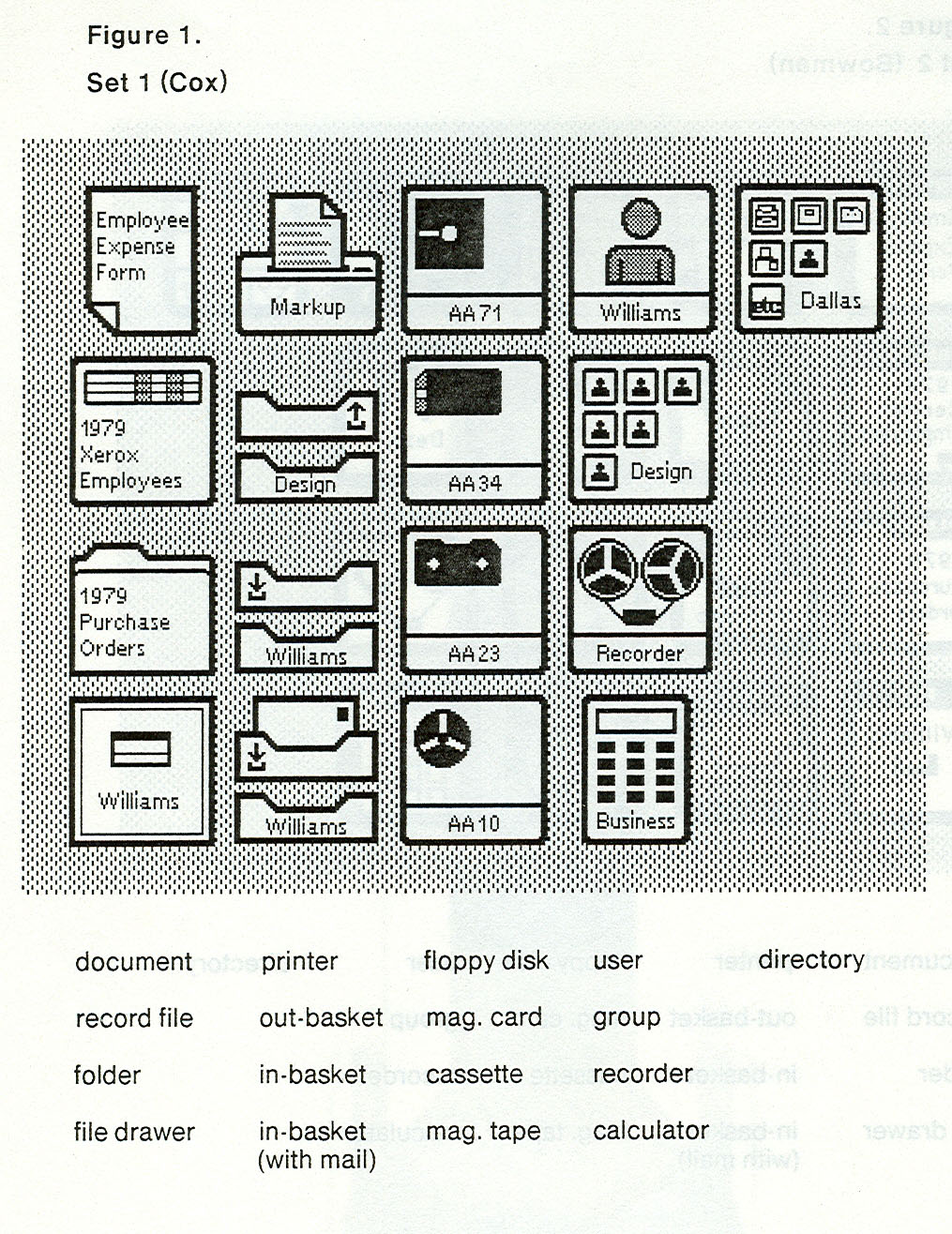
Xerox Star GUI Icon Ideas (circa 1979)
Norm Cox


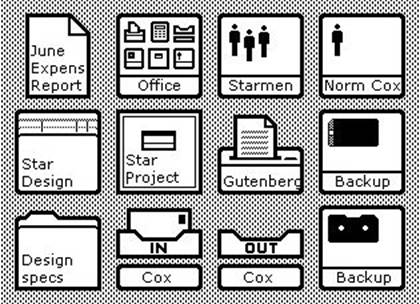
Xerox Star Final Icons (circa 1980)
Norm Cox et al

Saturday, 22 November 2008

Design Critique - initial commentors to read

Through an initial literature search of visual communication and graphic design the following people have been cited quite frequently. Some I know and have read, some are new. I list their names here merely as an aide-mémoire. I will comment on their critiques later. They are:

  • Rick Poynor - a writer and critic based in London specializing in visual culture
  • Nico MacDonald - a writer on the nexus of design, business and technology
  • Michael Rock - a founding partner and creative director at 2x4 and Professor of Design at the Yale University School of Art
  • Steven Heller - author, co-author or editor of over 100 books on graphic design


Additional update - Simon Biggs has given me the following names. Some I have read, some are new. I will source them when I return to the interactive literature after I have a visual communication literature position. The authors are: Jenny Preece, Alan Dix, Gillian Crampton Smith, John Maeda, Brian Reffin Smith, Brian Massumi, Brenda Laurel and Donald Norman. I list these names here as another aide-mémoire for future reference.

Tuesday, 4 November 2008

Developing a Research Position - Part 1 - Design Theory


I enhanced the previous diagram following a coffee tutorial with Chris. The new diagram concentrates solely upon the question about visual communication literature. Future diagrams will tackle the remaining questions. The essays quoted above are only a initial selection taken from a design theory reader (reference below). This enhanced diagram charts the first attempt at assigning relationships between the graphic design literature and interaction design. The links are untested and therefore are indicated as faint.

Bennet, A., ed., (2006) Design Studies: Theory and Research in Graphic Design. New York: Princeton Architectural Press

Monday, 3 November 2008

First visualisation of research

Based upon the whiteboard brainstorm I have attempted to clarify the information that that contained. This is a diagram to use in my next tutorial with Chris and to be understood in context to my previous Abstract draft.


On the image are several areas of questioning that can be expanded over the coming weeks through posts and tutorials.

Sunday, 26 October 2008

Abstract - 2nd draft

WORKING TITLE: Visual interactive design: narrative, social, spatial and temporal

Abstract
This paper will explore, from a visual communication perspective, the challenge of designing a graphical user interface for an online interactive product that takes into account interactivity, narrative and user-control in order to facilitate user-participation. I am specifically interested in how graphic design can visually record the linking traces that socially, spatially and temporally map contributors to an online project. These linking traces often can be narratives left by online projects' contributors.

How can these narratives be graphically represented? Once represented can each individual narrative form a larger narrative, creating a meta-narrative, shaped and formed by anyone who cares to interact with it? Can a visual language develop that clearly illustrates and communicates this data?

Focusing upon a practical pilot study this paper scrutinizes these questions through the design evolution of an online graphical user interface. It analyses and evaluates the submission, engagement and manipulation of user-contributed content within a digital environment and identifies which of the four narrative structures (Jenkins 2004) in its underlying narrative architecture is prevalent.

My research position is shaped by a desire to explore the graphic aspect of graphical user interfaces rather than from the technology/HCI/computer science disciplines. This paper adds to the discourse on how interactions can be facilitated by better graphic design, in order to expand visual communication literature and application to practice.

-------

This is a slightly reworked draft and is the abstract I submitted for critique and peer assessment. I'll feedback the comments I get in a later post.

Friday, 24 October 2008

Abstract - 1st initial draft

Here is the first draft of my abstract due in on Monday.

So far it is very rough but is shaping together in the right direction. I need to do a few redrafts to refine what I want to communicate. Any feedback would be useful at this stage.


This paper will explore, from a visual communication perspective, the challenge of designing a graphical user interface for an online interactive product that takes into account interactivity, narrative and user-control in order to facilitate user-participation. I am specifically interested in how graphic design can visually record the linking traces that socially, spatially and temporally map contributors to an online project. Can a visual language develop that clearly illustrates and communicates this data?

These linking traces often can be narratives left by online projects' contributors. How can these narratives be graphically represented? Once represented can each individual narrative form a larger narrative, creating a meta-narrative, shaped and formed by anyone who cares to interact with it?

Focusing upon a practical pilot study this paper explores these questions through the design evolution of an online graphical user interface, through multiple iterations to a final conclusion. It analyses and evaluates the submission, engagement and manipulation of user-contributed content within a digital environment and identifies which of the four narrative structures (Jenkins 2004) in its underlying narrative architecture is prevalent.

My research position is shaped by a desire to explore the graphic aspect of graphical user interfaces rather than from the technology/HCI/computer science disciplines. This paper will add to the discourse on how interactions can be facilitated by better graphic design, in order to expand the literature and application of practice.


Tuesday, 21 October 2008

Right, the next 5 years begins here

Right. End of stalling, procrastinating, hedging and misdirection. The hard research begins.

Here is the initial mapping of my research standpoint to date. This whiteboard brainstorm was drawn up in the presence of Dr. Chris Speed and Dr. Mark Wright of ECA on Tuesday 21st October.


It visually maps my main areas I have explored over the last 9 years. Some of the topic areas cover research I did on my Bachelors degree in Design and Art Direction at MMU* and on my Masters in New Media Production at ICDC†. My position to my proposed research will be graphic design-led, interactive and evaluative. My previous practice and education has been strongly rooted within visual communication but with a graphic design “hole”.

At this early stage I am nowhere near formalising my main research questions. My enquiry to date has been only loosely structured, but has followed paths through human-computer interaction, computer science, game design theory, sociology, human factors, experience design.

My Masters project neoTribe was a pilot project that began to explore the visual representation of ethnographic data, the dissemination of contributed narratives and the potential for the creation of meta-narratives. During today's tutorial Chris and Mark facilitated routes through this web of associations.

I will now try to sum up what I remember as my own associated path through this diagram. My starting position is within graphic design, but with a graphic design hole within my professional practice formed out of working as an illustrator, a publisher and interactive designer, rather than as a pure graphic designer. I teach on a graphic design degree on the theoretical, contextual, research and work-related aspects of design. My research therefore comes out of graphic design into the associated field of interactive design.

My stance is shaped by a desire to explore the graphic aspect of graphical user interfaces rather than from the technology/HCI/computer science direction. I am wishing to add to the discourse on how interactions can be facilitated by better graphic design. To aid this enquiry I am specifically interested in how graphic design can visually record the linking traces that map contributors to an online project socially, spatially and temporally. Can a visual language develop that clearly illustrates and communicates this data? I attempted this in neoTribe to a limited degree using techniques derived from Bertolt Brecht's Complex Seeing theories of representing information.

These linking traces can be recorded as narratives left by or contributed by the online project's contributors. How can these narratives be graphically represented? Once represented can each individual narrative form a larger narrative, creating a meta-narrative, shaped and formed by anyone who cares to interact with it?

This then throws up issues of agency and authorship, discussed through Foucault and Barthes. Narrative through interaction (rather than interactive fiction) has led me to look to Game Design Studies and Narratology, especially Henry Jenkins' paper on Narrative Architecture. Through discussion with Chris he also pointed me towards looking at Flow State by Mihály Csíkszentmihályi, a positive psychologist. Chris suggested taking a Situationist approach to the information. I'm not au fait with Situationism so I will have to have a discussion with my colleague in my staffroom when I get back to work to clue me in on the essentials.

Addendum Mark has reminded me that we also discussed "Mobile as well as web instantiations and this led to mentioning Michel De Certeau "walking the city" and tying the spatial/temporal into the narrative theme. Chris also mentioned Nigel Thrift."Thanks Mark.

This post has been written to record my thoughts soon after the tutorial. I will need to reflect upon what I have written and it will then help me to write the abstract I need to complete for Monday. Once I have written this I will post the abstract on this blog. Chris/Mark/Simon please feel free to comment as I know I said a lot more in the tutorial than I have written here, and I know I have not included a lot of salient points.

This is an open blog so anyone else reading this please also feedback your comments. I will translate this whiteboard into a diagram and put that in another post. By then I will be able to reduce my ideas into something more tangible to research.


* MMU = Manchester Metropolitan University
† ICDC = International Centre for Digital Content, part of Liverpool John Moores University

Thursday, 2 October 2008

Update

I have woefully neglected this blog in favour of another. Since my last post I have been leading a multi-disciplinary team of students and graduates on a Liverpool Biennial 2008 project.

This has been a massively ambitious project comprising of a live action/cg video, a project blog (currently private), a website, a DVD, a book and an academic paper. This project launches on 29th October with a private screening for invited guests. The video will then be exhibited in the The Blackie in Liverpool until the 20th November as part of Liverpool Biennial 2008. The video is De La Salle High School's entry to the Future, Fiction and Fantasy exhibition. Until the launch the video is confidential, afterwards I will include a link.

In the meantime I will tease you with this production image from the project…


On top of this I have also began my MPhil/PhD at Edinburgh College of Art. Within this capacity this blog will disseminate my research ideas.