Showing posts with label interaction design. Show all posts

Thursday, 28 May 2009

Mental Model Literature Review - Part 1

In this post I not only wish to contextually review the literature on mental models but also to define the use of the term that will be central to my first practical PhD project. Mental Models is unfortunately a term that has had its meaning diluted by non-cognitive science practioners such as Indi Young (more on this later). Therefore I will be exploring Mental Models firstly from a cognitive science perspective in order then to draw parallels and influences into Interaction Design. This post is not a defined thesis on my part but an attempt to draw together the essence of mental models. There will be theoretical holes in what I will post, so feel free to point them out. Look on what follows as simply my first attempt to stitch together my understanding of a very complex cognitive science discourse, from a discipline that is not my own. I will continue this literature review across several posts with the aim of refining my understanding.

------------

To begin with I am going to quote psychologist Kenneth Craik (1914-1945) from his 1943 book The Nature of Explanation. Craik is cited by cognitive scientist Johnson-Laird in his 1983 seminal work Mental Models as proposing the first modern hypothesis on humans being processors of information in order to understand phenomena.

”If the organism carries a “small-scale model” of external reality and of its own possible actions within its head, it is able to try out various alternatives, conclude which is the best of them, react to future situations before they arise, utilise knowledge of past events in dealing with present and future, and in every way to react in a much fuller, safer, and more competent manner to emergencies which face it.” (Craik, 1943, p57)

This statement was to open up a whole new area of research within the already new scientific discipline of cognitive science. By 1983 Mental Models research had two seminal works that explored this concept. Johnson-Laird proposed that the human mind uses propositional reasoning instead of reductive mathematical logic to understand phenomena. Gentner and Stevens, in their edited collection of papers, also entitled Mental Models, present a diverse range of views, including an early paper by Dr Donald Norman who here begins the discourse upon the Design Model. If Johnson-Laird proposes propositional reasoning, then Gentner and Stevens' book explores the structure of knowledge representations specific to different domains of application. Johnson-Laird states in introducing his book,

"The psychological core of understanding, I shall assume, consists in your having a 'working model' of the phenomenon in your mind. (…) you have a mental representation that serves as a model of an entity (…) A model has, in Craik’s phrase, a similar ‘relation-structure’ to the process it models, and hence it can be useful explanatorily; a simulation merely mimics the phenomenon without relying on a similar underlying relation-structure. Many of the models in people’s minds are little more than high-grade simulations, but they are none the less useful provided that the picture is accurate; all representations of physical phenomena necessarily contain an element of simulation." (Johnson-Laird, 1983, p2/4)

The importance here is that a 'relation-structure' the functionality of a cognitive conceptual model. To propose an explanation on how a phenomenom works, a model that is constructed by a person is NOT improved by them also trying to understand the specific context it is encountered in. The specific context is not transferable to another context but the mental model will be. The model will not be complete each time it is applied, but in Chomsky's term 'explanatory adequate'. To Johnson-Laird because a mental model is constructed by mental logic, mental logic has six main problems. Inference, formulation and deduction all are contributory to the empirical nature of mental logic. He lists the problems as (pp39-40):

  1. People make fallacious inferences.

  2. Which logic, or logics, are to be found in the mind?

  3. How is logic formulated in the mind?

  4. How does a system of logic arise in the mind?

  5. What evidence there is about the psychology of reasoning suggests that deductions are not immune to the content of the premises.

  6. People follow extra-logical heuristics when they make spontaneous inferences.


People's powers of deriving a reasoned solution based upon a premise they have, or from precedence is strongly affected by their own cognition that is deceptive. Mental models, although helpful to understanding a phenomenon, are inherently 'incomplete' (Johnson-Laird, 1983)(Norman, 1983), 'doubtful validity' (Norman, 1983), 'fragmentary' (Norman, 1998), 'dynamically constructed' (Preece et al, 1995), and 'not always correct' (Gentner and Gentner, 1983). As Johnson-Laird argues, the formulation of a mental model to understand a phenomenon is 'propositional reasoning' on behalf of each individual. Norman explains this in more accessible terms:


"The power of mental models is that they let you figure out what would happen in novel situations. Or, if you are actually doing the task and there is a problem, they let you figure out what is happening. If the model is wrong you will be wrong too." (Norman, 1998, p71)


If the person's proposition regarding the causality, relationships and mechanisms within a phenomenon encountered is poorly appreciated then their understanding of that phenomenon will not work. But an incomplete proposition that does capture the behaviour of that phenomenon, that for them represents the causality and mechanisms of that phenomenon based upon previous experiences, or from fragmentary experiences of aspects of similar phenomena, can arrive at an 'explanatory adequate' mental model. This is why Norman describes the human mental process as "unscientific" that supports Johnson-Laird's argument that humans do not use reductive mathematical logic as the brain is a computer. In their book The Embodied Mind Varelo et al refer to phenomenologist Edmund Husserl (1859-1938) to contextualise human cognition from a different perspective, where a human's 'sensorimotor capacities' is enabling enough to successfully interact within an environment with the phenomenon. According to their thesis Husserl claimed


"that to understand cognition, we cannot take the world naively but must see it instead as having the mark of our own structure. He also took the second step, at least partially, in realizing that that structure (the first step) was something that he was cognizing with his own mind.(…)He explicitly focused on the experience of consciousness in what he called the “lived-world.” The lived world is not the naive, theoretical conception of the world found in the natural attitude. It is, rather, the everyday social world, in which theory is always directed toward some practical end. Husserl argued that all reflection, all theoretical activity, including science, presupposes the life-world as a background. The task of the phenomenologist now became the analysis of the essential relation between consciousness, experience, and this life-world.” (Varelo et al, 1996, pp16-17)


For each person to construct a mental model of a phenomenon based upon proposition reasoning, entails them cognizing the problem from their previous experiences built into a appropriate functional model (Preece et al, 1995) developed from existing knowledge of a similar context. As a mental model is a dynamic conceptual tool to solve a problem within a phenomena, they can be be said to be drawn from Husserl's concept of the 'lived-world'.

-----

References


See Design Model - statement for list of references cited in this post.


Thursday, 26 March 2009

1st Practical PhD Project… thoughts

On my project blog PhD Project 01 I am still documenting research upon the cognitive psychology of users' mental models which will take me into April as I need to source a couple of key texts I couldn't get from ECA's or University of Edinburgh's libraries. That said one key text yesterday, firmly situated within cognitive science literature, has suggested a structure for my practical research project. I will expand upon this again over the coming months in more detail.

The idea so far in its embryonic state is this…

    Phase
  1. Qualitative Experiment on up to 36 subjects to undergo an initial online survey to identify a capacity to describe and communicate a cognitive model (subject to be defined). The subjects who can clearly communicate their 'mental model' will be graded into study groups for the next phase.
  2. This study group will then be asked to explain how they understand how they perform an interactive task.
  3. These 'mental models' will be visually documented.
  4. From this documentation visual interactive prototypes will be produced as iterative tests of a 'designer's model'.


I do realise that this is very woolly right now and lacks definition. It's root is in an experiment performed by Dedre Gentner and Donald R. Gentner disseminated in their 1983 paper "Flowing Waters or Teeming Crowds: Mental Models of Electricity". My outcome will be demonstrably different to theirs, but their method is certainly a foundation to develop on. I will continue to work on this planning over April.

To summarize though what my intended outcome will focus upon: it will be creating a range of interaction prototypes that are define and designed using 'designer models' interpreting users' 'mental models' of the interaction. The outcome will be focused on visually communicating the experimentations of matching an interface design to how a user thinks it works rather than how it works.

I know I can communicate this better, so please bear with me as I begin to form my methodology and outcomes. Any comments would be greatly received, but please add them to this post by clicking 'Comments' rather than emailing them. Once I have the project more defined I will utilise the Interaction Design community www.ixda.org to inform me of any similar experiments, to ensure I am doing and experiment that will open new ground.

The final thing I need to emphasize is that this project will focus on the visual communication of the interactive process.

Reference:

Gentner, D. & Gentner D.R. (1983) Flowing Waters or Teeming Crowds: Mental Models of Electricity. In D. GENTNER, and A.L. STEVENS, eds. Mental Models. Lawrence Erlbaum Associates Inc. pp99-129

Friday, 20 March 2009

IxDA Basecamp

I've just been invited to join the IxDA Basecamp, an offshoot of the Interaction Design Association where interaction designers can "collaborate on IxDA Basecamp projects. You can post messages and comments about your work here for the group to see." I've just posted the following announcement on the group at http://ixdg.grouphub.com/projects/1622075/project/log. You will need to join the association to view it. I am now officially a 'group leader'.

Interaction Design from a visual communication perspective

Hi IxD community,

I’m Dave Wood a lecturer in Interaction Design from the UK. I’m based in Liverpool and I’m engaged in part-time doctoral study at Edinburgh College of Art on a practice-based PhD.

Between now and 2013 I will be researching interaction design from a visual communication perspective. In doing so I will design and run three design projects to test and measure my research. I would welcome any comments and input from the IxD community.

I have two blogs that disseminate my research and a paper entitled “Interaction Design: Where’s the Graphic Designer in the Graphical User Interface?” available from my academia.edu profile. Feel free to view any of these, the links are:

newmediabazaar.blogspot.com/
phdproject01.wordpress.com/
sthelens.academia.edu/DaveWood

Now that I am a member of this group I will also disseminate my research and project progress here.

Sunday, 1 February 2009

Gillian Crampton Smith links

"Interaction design is the creative design of the interaction between people and devices, systems or services. This interaction usually involves the ‘new technologies’ of computing and communications. But interaction design remains a design activity – like architectural, graphic or product design. And it concerns the social value and cultural meaning of what is designed, not only its functional efficiency and visual appeal." Gillian Crampton Smith and Philip Tabor 2007-08
http://www.interaction-venice.com/index.html

Through some research on designers of interfaces on Google Images I followed some Gillian Crampton Smith links to Crampton Smith and Philip Tabor's website. On it they have a reading lists for Interaction Design, Information Visualisation and other useful links which I reproduce here in order to archive them for future quick reference.

======

From http://www.interaction-venice.com/references-introductory.html

Introductory references

Strongly recommended

Bonsiepe, Gui. 1995. Dall’oggetto all’interfaccia. Mutazioni del design. Milan: Feltrinelli. (English trans: Interface: An Approach to Design. Maastricht: Jan van Eyck Akademie.)

Moggridge, Bill. 2007. Designing Interactions. Cambridge: MIT Press.

Negroponte, Nicholas. 1995. Being Digital. New York: Alfred A. Knopf.
2004. Essere digitali. Milano: Sperling and Kupfer

Norman, Donald A. 1997. La caffettiera del masochista. Psicopatologia degli oggetti quotidiani. Florence: Giunti. (Trans. of The Psychology of Everyday Things. New York: Basic Books. 1988.)

Reas, Casey, and Ben Fry. 2007. Processing: A Programming Handbook for Visual Designers and Artists. Cambridge: MIT Press.

Saffer, Dan. 2006. Designing for Interaction: Creating Smart Applications and Clever Devices. Berkeley CA: Peachpit.

Thackara, John. 2006. In the Bubble: Designing in a Complex World. Cambridge MA: MIT Press.

White, Ron. 2004. Il computer. Come è fatto e come funzione, 7th edn. Milan: Mondadori. (Trans. of How Computers Work. Indianapolis: Que. 2006.)

Recommended

Botta, Massimo. 2006. Design dell’informazione. Tassonomie per la progettazione di sistemi grafici auto-nomatici. Trento: Artimedia.

Cameron, Andy, ed. 2004. The Art of Experimental Interaction Design (IdN Special O4). Hong Kong: IdN Publishing.

Caplin, Steve. 2001. Icon Design: Graphic Icons in Computer Interface Design. New York: Watson-Guptill.

Cooper, Alan, Robert Reimann, and David Cronin. 2007. About Face 3.0: The Esssentials of Interaction Design. New York: Wiley.

Cooper, Alan. 1999. Il disagio tecnologico. Perché i prodotti high-tech sono così difficili da usare e che cosa fare per migliorarli. Milan: Apogeo. (Trans. of The Inmates are Running the Asylum: Why High Tech Products Are Driving Us Crazy and How to Restore the Sanity. Indianapolis: Sams. 1999.)

Garito, Maria Amata, Giovanni Anceschi, and Massimo Botta. 2006. L’ambiente dell’apprendimento. Web design e processi cognitive. Milan: McGraw-Hill.

Maeda, John. 2004. Creative Code: Aesthetics and Computation. London: Thames & Hudson.

Norman, Donald A. 1995. Le cose che ci fanno intelligenti. Il posto della tecnologia nel mondo dell'uomo. Milan: Feltrinelli, Milano, 1995. (Trans. of Things that Make Us Smart: Defending Human Attributes in the Age of the Machine. Reading MA: Addison-Wesley. 1993.)

Petzold, Charles. 2000. Codice. Il linguaggio segreto dei computer. Milan: Mondadori. (Trans. of Code: The Hidden Language of Computer Hardware and Software. Redmond WA: Microsoft Press. 1999.)

Preece, Jenny, Yvonne Rogers, and Helen Sharp. 2007. Interaction Design: Beyond Human-Computer Interaction, 2nd edn. New York: Wiley. (Italian trans. of 1st edn: Interaction Design. Milan: Apogeo. 2004)

Studio 4.5 (Carola Zwick, Burkhard Schmitz, and Kerstin Kuhl). 2006. Designing for Small Screens: Mobile Phones, Smart Phones, PDAs, Pocket PCs, Navigation Systems, MP3 Players, Game Consoles. Switzerland: Ava.


======

From http://www.interaction-venice.com/references-infoviz.html

Information visualisation references

INFORMATION DESIGN BOOKS

Bertin, Jacques. La Semiologie Graphique.

Tufte, Edward R. 1983. The Visual Display of Quantitative Information. Cheshire CT: Graphics Press.

- 1990. Envisioning Information.
- 1997. Visual Explanations
- 2006. Beautiful evidence

ICON DESIGN BOOKS

Caplin, Steve. 2001. Icon Design: Graphic Icons in Computer Interface Design. New York: Watson-Guptill.

INFORMATION VISUALISATION LINKS
Periodic Table of visualisation techniques
http://www.visual-literacy.org/periodic_table/periodic_table.html

Gallery of network visualisations
http://www.visualcomplexity.com/vc/

Information aesthetics
http://infosthetics.com/

Nice magnifying list (Jonathan Harris)
http://tenbyten.org/10x10.html

Jonathan Harris’s site
http://www.number27.org/

David Lu’s projects
www.velluminous.org
http://velluminous.org/portfolio/detail/?14

Visualising conversations:
(Boris Muller)
http://www.forestandthetrees.com/findr/findr.html
(Mike Migurski)
http://backchannel.stamen.com/

Semantic links between websites (only still pix at the moment)
http://www.ralphammer.de/projects/sinnzeug/sinnzeug_en.html

Power links between companies (Josh On)
http://www.theyrule.net/
(other work by Josh)
http://www.futurefarmers.com/josh/rca/index.html

Hyperbolic net visualisations
Visual thesaurus
Hypergraph - Hyperbolic graphs and trees : ThinkMap
KartOO visual meta search engine

Inxight: a spin off from Xerox Park from the visualization team of Stu Card
http://www.inxight.com/products/sdks/
Inxight StarTree
Inxight TimeWall
Inxight TableLens
(Inxight has been acqired by SAP. At present there are no pictures or demos on the site. Google 'hyperbolic visualisation' to find similar examples. 1/dec/2008)

Map of creativity
http://www.ngf.org.uk/map/map.html

Explore the Flikr space
http://www.quasimondo.com/tagnautica.php

World development statistics
G A P M I N D E R: HOME

Semantic Indexing
http://www.knowledgesearch.org/

Timelines (look at the live examples)
http://simile.mit.edu/timeline/

AT&T telecoms company’s visualisation research group
http://www.graphviz.org/Gallery.php

Overview of the stockmarket
www.smartmoney.com (look at Tools in the menu on the left)


======

From http://www.interaction-venice.com/references-useful-links.html

Useful links

GENERAL

Long running and important comment on ‘what is new technology for?’
http://www.doorsofperception.com/

Live|Work Service Design. Live|Work have pioneered service design as a design activity.
http://www.livework.co.uk/home.html

Interaction Design Association: a lot of interesting discusssions and resources
http://www.ixda.org/

Rather sharp blog on interaction design!
http://www.odannyboy.com/blog/archives/001000.html

Looks good, works well
Looks Good Works Well: Storyboarding Interesting Moments
http://looksgoodworkswell.blogspot.com/2005/11/interaction-matrix.html

We make money not art: design/technology/art
http://www.we-make-money-not-art.com/archives/009123.php

TECHNIQUES

Working with users
Cooper on personas (his company invented the name)
http://www.cooper.com/content/insights/newsletters_personas.asp

Working with users for service design
http://courses.interaction-ivrea.it/zoom/CirclesOfCare/index.html

IDEO’s methods cards
www.ideo.com/methodcards/MethodDeck/

Experience prototyping (Jane Fulton Suri, Marion Buchenau)
http://www.ideo.com/media/info.asp?x=6

Bill Gaver, Tony Dunne, Elena Pacenti: Cultural Probes
ACM Interactions Magazine February 1999
Flowcharting
Basic Flowcharting Symbols - The SmartDraw Flowchart Tutorial
Introduction to User Interface Flow Diagrams (UI Storyboards)

‘Quick and dirty’ video prototyping
http://insitu.lri.fr/imuseum/symposium1-results.html

Hill and Houde: "What do prototypes Prototype?"
http://www.viktoria.se/fal/kurser/winograd-2004/Prototypes.pdf

http://www.design.philips.com:80/about/design/section-13482/index.html

Information architecture tools
http://iainstitute.org/en/learn/tools.php

SOME NICE INTERACTIONS

Fresh interfaces for architects
http://www.intentionallies.co.jp/content_normal.html
http://www.andreescu-gaivoronski.com/and_gaiv.htm

Magical mystery tour
http://99rooms.terracontent.de/99rooms/99rooms.html

Flikr clock
http://www.quasimondo.com/clockr.php

Rijksmuseum: a beautiful light, delicate, pleasurable experience—a widget for the Macintosh
http://www.rijksmuseum.nl/aria/aria_assets/SK-C-210?lang=en

Elegant loading animation
http://www.sekisuiheim.com/desio-ae/

Animation sketch style
http://www.loworks.org/

Friday, 30 January 2009

Cognitive Modelling: Norman's 'Designer's Model'


Currently I am reading About Face 3 (Cooper et al.). In chapter 2 it deals with the existing position, dictated by software, of humans having to understand how computers 'logically' behave. Interaction design aims to rebalance digital products in favour of the human rather than the machine. By facilitating clearer cognitive behavioural understanding in the user, interactions can be made more beneficial to the user. Where this chapter really begins to become useful is in its explanation of conceptual models in order to visualise how humans and computers work.

The first model Donald Norman refers to as the system model. This is the cognitive model that explains the processing structure of the code. About Face 3 prefers to refer to it as the implementation model.

How code processes its actions and how human beings believe a computer/device/machine works are not the same. The human's mental model of how it works can be simplistic, counter-intuitive, fanciful, inaccurate, illogical; but as long as it helps the human successfully use their computer/device/machine it doesn't matter to them. Where a lot of problems arise within interactivity is the chasm that can form because these two mental models are representationally different. One is a mapping of actual processes - 'implementation', the other is purely notional - 'explanation'.

To interface between 'implementation' and 'explanation' a third model arises, a model that Donald Norman refers to as the designer's model, and Cooper et al refers to as a represented model. A designer's model that maps closer to a system/implementation model maybe more 'accurate' to the actual mechanics of processing, but is cognitively problematic to human users [A in diagram].

A successful interface is one where a user can see how their "goals and needs can be met" (Cooper et al, 2007, p32). This is achieved through making the designer's model follow as closely as possible the users' perceptions of how they believe they access the content [C in diagram].

There is nothing ground-breaking here in regard to interaction design, but it is the first time I have come across these definitions. I have known of the butler metaphor (Isaacs & Walendowski, 2002) but Cooper and Norman's models give it a more theoretical depth. Below is an expansion of the diagram in About Face 3 on page 30, with my annotations that link it back to my recent paper on the location of the graphic designer in GUI design.


Norman's designer's model and Cooper et al's similar represented model helps to give a cognitive psychological and theoretical base to the role that underpins the work of interface designers. In my paper I wrote about and cited Gillian Crampton Smith, former school director of Interaction Design Institute Ivrea. She sees the "graphic designers’ role as more involved in the interactive design process 'designing what a package is and what it does, and then designing what it will be like' (Aymer, 2001a, p33)". Graphic designers as part of their practice alternate between the “consideration of objective information and intuitive leaps” (Frascara, 2006, p32) in order to arrive at successful visual solutions. Graphic design, when performed well, can “inspire a behavourial change” in its audiences (Forlizzi & Lebbon, 2006, p53). These three points I raised and discussed in my paper can now also be assessed within the framework of the designer's model, and how effective are visual solutions when measured against the user's mental models.


References:

AYMER, G. (2001)a Norman Cooking. Create Online. 8. p38-40

COOPER, A., REIMAN, R. and CRONIN, D. (2007) About Face 3: The Essentials of Interaction Design. Indianapolis: Wiley Publishing Inc.

FRASCARA, J. (2006) Graphic Design: Fine Art or Social Science. In: A. BENNETT, ed. Design Studies: Theory and Research in Graphic Design - A Reader. New York: Princeton Architectural Press, p26-35

FORLIZZI, J. and LEBBON, C. (2006) From Formalism to Social Significance in Communication Design. In: A. BENNETT, ed. Design Studies: Theory and Research in Graphic Design - A Reader. New York: Princeton Architectural Press, p51-63

ISAACS, E. & WALENDOWSKI, A. (2002)Designing from Both Sides of the Screen: How Designers and Engineers Can Collaborate to Build Cooperative Technology. New Riders Publishing

Back to Top

Friday, 23 January 2009

Current update on research position


Following the completion of my first paper demonstrating the development of my research I thought I'd best keep sight of where my research position currently stands. Below is a diagram I have produced, based upon a diagram explaining user experience, that I believe locates my bibliographic sources to date. The original diagram is from About Face 3 by Alan Cooper et al.*

The Diagram
The diagram below has been adapted and annotated to place additional information upon it that supports the locating of my current references. These locations are relative, emblematic and arbitrary, serving only to spatially identify where I believe my literature review is concentrated. I am initially weighting it from the visual communication perspective, but in order to balance it I have dialectically balanced it with sources from computer science (sources 10 & 19) and interaction design (sources 16, 17 & 25) literature. The numbering relates directly to the bibliography of 28 sources I used for the paper. The bibliography follows. In the next phase of research I am moving my position more towards the interaction sphere of literature from visual communication.


The Current Bibliography
1. AYMER, G. (2001)a Norman Cooking. Create Online. 8. p38-40

2. AYMER, G. (2001)b Interaction Guaranteed. Create Online. 10. p32-33

3. AYMER, G. (2002) The Big IDEO. Create Online. 29. p48-51

4. BRUINSMA, M. and VAN DER MEULEN, S. (2003) Deep Sites: Intelligent Innovation in Contemporary Web Design. London: Thames & Hudson Ltd

5. BURGOYNE, P. (2002) GB: Graphic Britain. London: Laurence King Publishing

6. CROWLEY, D. (2004) Design Magazines and Design Culture. In: R. POYNOR, ed. Communicate: Independent British Graphic Design since the Sixties. London: Laurence King Publishing Ltd., pp182-199

7. FRASCARA, J. (2006) Graphic Design: Fine Art or Social Science. In: A. BENNETT, ed. Design Studies: Theory and Research in Graphic Design - A Reader. New York: Princeton Architectural Press, p26-35

8. FORLIZZI, J. and LEBBON, C. (2006) From Formalism to Social Significance in Communication Design. In: A. BENNETT, ed. Design Studies: Theory and Research in Graphic Design - A Reader. New York: Princeton Architectural Press, p51-63

9. HELLER, S. (2006) Better Skills Through Better Research. In: A. BENNETT, ed. Design Studies: Theory and Research in Graphic Design - A Reader. New York: Princeton Architectural Press, p10-13

10. JOHNSON, J., ROBERTS, T.L., VERPLANK, W., SMITH, D.C., IRBY, C., BEARD, M. AND MACKEY, K. (1989) The Xerox "Star": A Retrospective. [online] (accessed on the World Wide Web 4/1/2009 http://www.digibarn.com/friends/curbow/star/retrospect/)

11. LAUREL, B. ed (2003) Design Research: Methods and Perspectives. London: MIT Press

12. MACDONALD, N. (2003) What is Web Design?. Hove: RotoVision SA

13. MACDONALD, N. (2004)a British Web Design: A Brief History. In: R. POYNOR, ed. Communicate: Independent British Graphic Design since the Sixties. London: Laurence King Publishing Ltd., pp200-215

14. MACDONALD, N. (2004)b The British Evasion: How they missed the boat in yet another revolution led by the Americans. Print. 58(6) p38, 332

15. MACDONALD, N. (2004)c In With the New. Creative Review. 24(9) pp49-50, 52

16. MOGGRIDGE, B. (2007) Designing Interactions. MIT Press

17. NORMAN, D.A. (1998) The Design of Everyday Things. MIT Press

18. O’REILLY, J. (2004) Thinking with Images. In: R. POYNOR, ed. Communicate: Independent British Graphic Design since the Sixties. London: Laurence King Publishing Ltd., pp216-231

19. PERRY, T.S. and VOELCKER, J. eds. (1989) Of mice and menus: Designing the user-friendly interface. Reprinted from IEEE Spectrum, September 1989, pp. 46-51. [online] (accessed from the World Wide Web 30/12/08 http://www.guidebookgallery.org/articles/ofmiceandmenus)

20. POYNOR, R. (1999) Made in Britain: The Ambiguous Image. In N. BARLEY et al. Lost and Found: Critical Voices in New British Design. London: Birkhauser Verlag AG/The British Council. Pp 28-31

21. POYNOR, R. ed. (2003) No More Rules: Graphic Design and Postmodernism. London: Laurence King Publishing Ltd.

22. POYNOR, R. (2004) Spirit of Independence. In: R. POYNOR, ed. Communicate: Independent British Graphic Design since the Sixties. London: Laurence King Publishing Ltd., pp.12-47

23. ROACH, G. (2002). More Than Words. Create Online. 27, July. pp48-51

24. ROCK, M. and POYNOR, R. (1995) What Is This Thing Called Graphic Design Criticism? Eye. 4 (16) pp56-59

25. SAFFER, D. (2007) Designing for Interaction: Creating Smart Applications and Clever Devices. Berkley, CA: New Riders

26. TOGNAZZINI, B. (1998) The Sorry State of Web Design. [online] (accessed on the World Wide Web 2/1/2009 http://www.asktog.com/columns/015WebDesignRant.html)

27. TOGNAZZINI, B. (2000) Elephants in the Living Room: The Destructive Role of Denial in Web Design. [online] (accessed on the World Wide Web 2/1/2009 http://www.asktog.com/columns/039Elephant.html)

28. TOGNAZZINI, B. (2003) It's Time We Got Respect. [online] (accessed on the World Wide Web 2/1/2009 http://www.asktog.com/columns/057ItsTimeWeGotRespect.html)


*Cooper, A., Reiman, R. and Cronin, D. (2007) About Face 3: The Essentials of Interaction Design. Indianapolis: Wiley Publishing Inc. p xxxi
Back to Top

Monday, 12 January 2009

Where’s the graphic designer in the graphical user interface?

It's been a while since I last posted as I had a paper to research and write. The paper "Where’s the graphic designer in the graphical user interface?" informs my contextual review and the findings within it aid the positioning of myself within interaction design research from a visual communication perspective.

I will only give a summary here and briefly outline my intention for its use.

The paper charts the involvement of graphic designers within the development of graphical user interfaces (GUI) across software and online/offline digital products since the 1970s. This is in order to discover what influence and involvement graphic design, as a discipline, now bears upon interaction design. The paper is limited to 3,000 words and so does not go into the history of GUI development.
The paper can be downloaded here as a pdf.

To support the paper I wish to add here some images that were useful to my research. The paper is intentionally unillustrated as, although it is about a visual medium, I wished the text to position the past, current and future state of graphic designers' involvement before I then move the research onto actual practioners. Therefore the images I am posting below are the starting point for the next paper I propose upon this research. This will then form the first part of my contextual study moving deeper into interaction design literature, before exploring the other areas of the diagram in previous posts.

A History of the GUI Timeline


Jeremy Reimer
arstechnica.com/articles/paedia/gui.ars/8 | Published: May 05, 2005

Original Apple Icon Graphics
Susan Kare


Original Apple MacPaint Graphics
Susan Kare


Original Apple Typography
Susan Kare


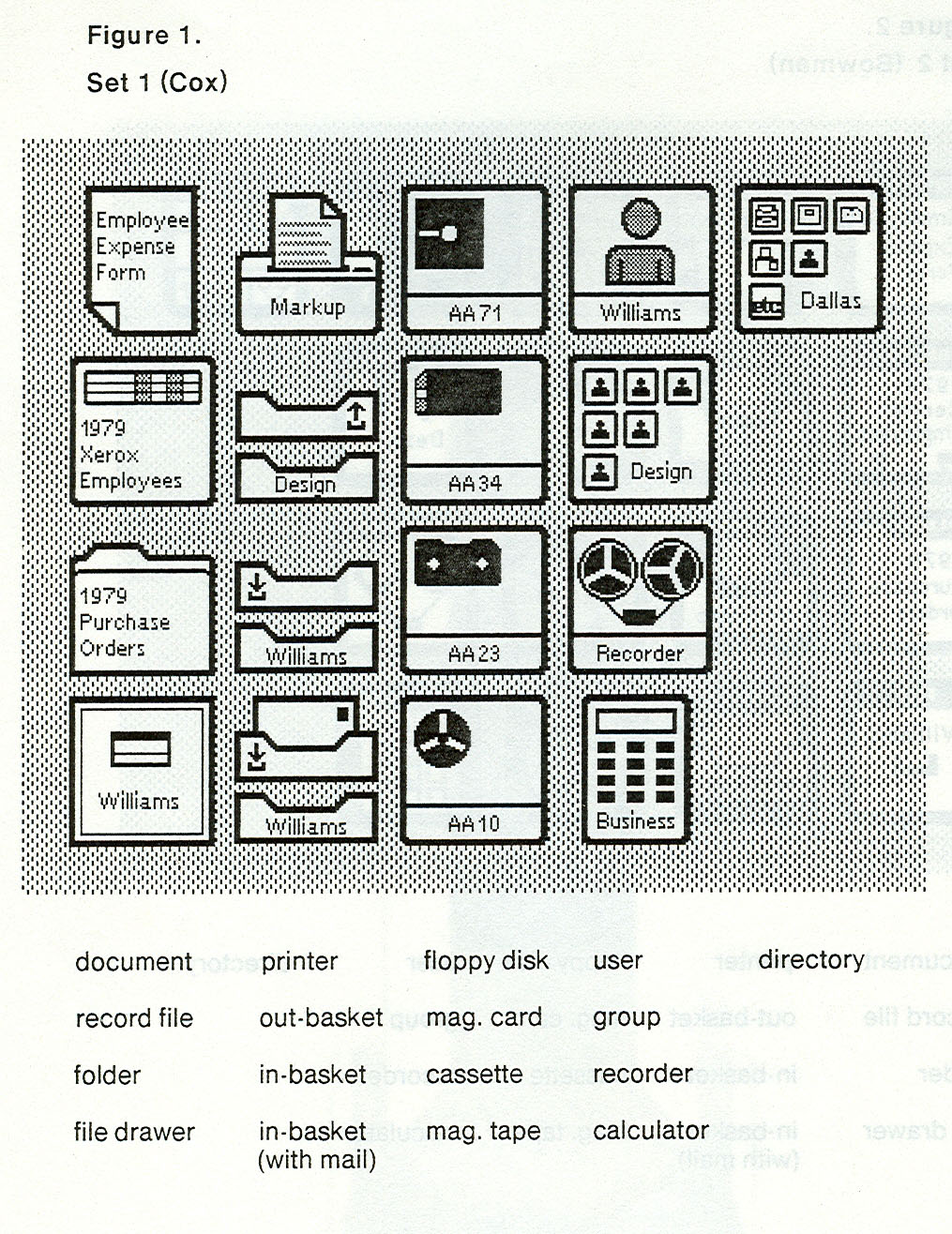
Xerox Star GUI Icon Ideas (circa 1979)
Norm Cox


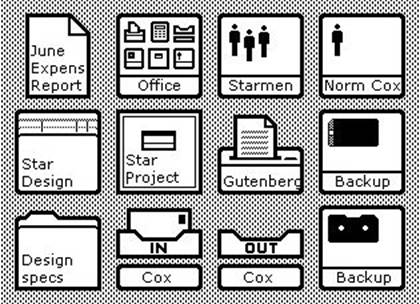
Xerox Star Final Icons (circa 1980)
Norm Cox et al

Tuesday, 27 May 2008

Trigger::Interaction::Resolution

I have been focused upon posting to two other blogs, one which is my annotated bibliography (seek previous post). In the latest post to annotatedBib I have made a connection between an explication of interaction design by Bill Verplank of Ivrea and Stanford, and an explication of experience design by August de los Reyes. These can be summed up in the following diagrams based upon originals.


Interaction Design: Bill Verplank


Experience Design: August de los Reyes


I see there is a correlation between these two concepts that help to describe the interaction experienced by a user.

For every interaction there is a trigger to set it off. This results in a resolution to the interaction. This resolution in turn sparks off another trigger and so the cycle continues.

Mapping this experience cycle onto Verplank's diagram the user must first know what the trigger is and then do something to set it off. The interaction is communicated by a combination of aural, visual and/or tactile feedback leading to the final resolution.

This resolution can be experienced emotionally, physically, sensory, cognitively and intellectually. The user then feels that something has happened and the interactive cycle can continue until the desired task has been achieved.

By mapping the experience to the interactive cycle it is possible to understand the process of designing a successful interface. After all, as Verplank puts it "It is the responsibility of the designer to help people understand what is happening!"

References
de los Reyes, A. (2002) Flash Design for Mobile Devices, Hungry Minds Inc. p36