I've been taking Level 2 undergraduates from Graphic Design and Games Design for Research Techniques and this week I was getting them to discuss their propositions for a research project. One Graphic Design student had decided upon "What makes a good design?" as her initial investigation. I had during the group tutorial made each student really think about their questions so that they were looking at a specific area of inquiry rather than being too broad. I got this student to consider that 'good' had to be defined clearer as it was too subjective and also what she meant by design. Design like art is a word that everyone knows what it means but can never truly agree a definition. In order to further illustrate my point to the students I used my own experience of researching interactivity.
During my research I have come across many different papers all attempting to address the definition of interactivity. To illustrate this I will discuss a few of them here.
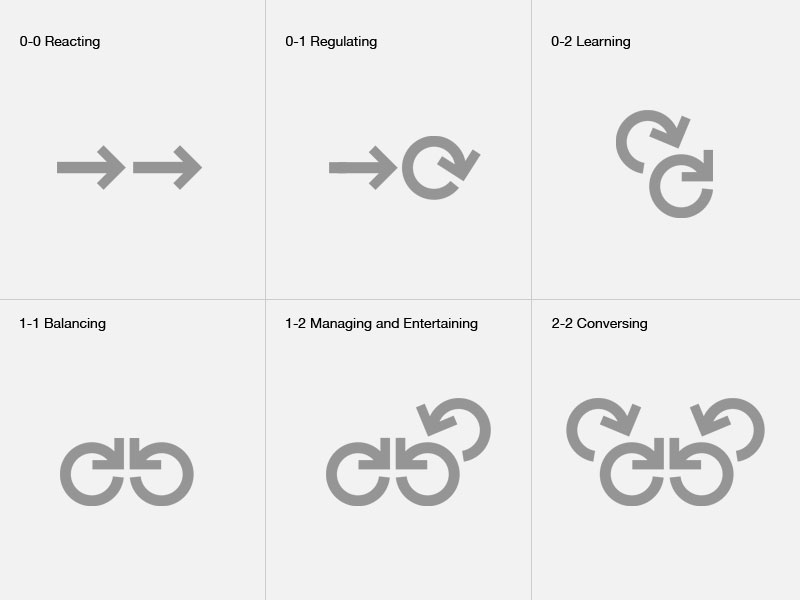
The Interactive TypologyAs cited in a paper by Rob Cover (Cover, 2006) Sally McMillan draws upon other work by Bordewijk and van Kaam (1986), into a four level classification of (a)
Allocution, (b)
Consultation, (c)
Registration and (d)
Conversational interactivity. Essentially (a) passive audience involvement,
ie: watching TV (b) database dissemination of content upon user request, (c) more dynamic dissemination through collection of patterns of engagement by the user,
ie: browser cookies (d) Face-to-Face (F2F) real-time communication.
In another paper McMillan and co-author Downes (Downes & McMillan, 2000) are thorough enough to provide further definitions that I will lay out here.
Exertive InteractivityWhere the user exerts more effort to accomplish a task when it comes to the use of digital media compared to older media that is more passive. This is a form suggested by Heeter (1989).
Interchangeable RolesThe positions of role-taking and providing feedback are interchangeable allowing mutual discourse between communicating entities (Rice, 1984) & (Rogers, 1995)
.MODThe amount of real-time modification a user can perform upon the content whilst interacting with it. (Steur, 1992)
Two-way ExchangeWhether real-time or asynchronous both Rice and Williams (1984) and Rheingold (1993) both suggest that media can only be interactive if it has the potential for two-way exchange between entities whether these are human or processor.
Downes and McMillan do admit these terms are contradictory and have drawn attention to the need for a more consensual definition, but I am not the person to do this. Obviously. But the need to understand your medium is important to any designer and interactive design is no different. I will come back to these defining terms in another post once I have time to ruminate on this post. This is the first time I have actually brought this research together and what you are reading
is my research in progress.
References:
Cover, Rob (2006)'Audience inter/active: Interactive media, narrative control and reconceiving audience history', in New Media & Society Vol6(4):487–506, pp.142, SAGE Publications
Downes, Edward J. & Mcmillan, Sally J. (2000) 'Defining interactivity: A qualitative identification of key dimensions', in New Media & Society Vol2(2):157–179, pp.159, SAGE Publications
Heeter, C. (1989) ‘Implications of New Interactive Technologies for Conceptualizing
Communication’, in J.L. Salvaggio and J. Bryant (eds) Media Use in the Information
Age: Emerging Patterns of Adoption and Computer Use, pp.221–5. Hillsdale, NJ:
Lawrence Erlbaum Associates.
McMillan, S. (2002) ‘A Four-Part Model of Cyber-Interactivity: Some Cyber-Places are
More Interactive than Others’, New Media & Society4(2): 271–91.
Rice, R.E. (1984) ‘New Media Technology: Growth and Integration’, in R.E. Rice
(ed.) The New Media: Communication, Research, and Technology, pp.33–54. Beverly Hills, CA: Sage.
Rice, R.E. and F. Williams (1984) ‘Theories Old and New: The Study of New Media’,
in R.E. Rice (ed.) The New Media: Communication, Research, and Technology, pp.55–80.
Beverly Hills, CA: Sage.
Rogers, E.M. (1995) Diffusion of Innovations (4th edn). p314. New York: Free Press.
Rheingold, H. (1993) The Virtual Community: Homesteading on the Electronic Frontier. New
York: Addison-Wesley.
Steur, J. (1992) ‘Defining Virtual Reality: Dimensions Determining Telepresence’, Journal of Communication 42: 73–93.